 Add to Chrome
 Add to Firefox
 Add to Edge
ReasonLight: A Multimodal Foundation Model-Enhanced Reinforcement Learning Framework for Zero-Shot Traffic Signal Control
May 28, 2026
Reinforcement learning (RL) has shown promise in traffic signal control (TSC). However, its reliance on predefined states limits responsiveness to observable open-world events that are absent from training data. IoT-enabled intersections provide heterogeneous observations from roadside sensors and cameras, creating opportunities to improve RL adaptability to such events. To this end, we propose ReasonLight, a multimodal foundation model-enhanced RL framework for zero-shot TSC. ReasonLight integrates three sources of information: structured traffic measurements, multi-view camera observations, and candidate phase decisions from a pre-trained RL controller. Given an RL-proposed phase, ReasonLight extracts visual semantics from multi-view images and aligns them with compact sensor-derived scene descriptions. This alignment enables a semantic-guided refinement module to either preserve or adjust the proposed action according to traffic rules and event semantics. To ensure operational reliability, refined actions are constrained by the set of available phases. Any invalid decision is rejected, and the system falls back to the original RL action. We evaluate ReasonLight on two types of rare events not seen during RL training: emergency vehicle priority and temporary traffic regulation. Experimental results show that ReasonLight achieves zero-shot adaptation without retraining. It reduces emergency vehicle waiting time by up to 88.7% compared with the RL-only backbone while preserving comparable routine traffic performance.

DiCLIP: Diffusion Model Enhances CLIP's Dense Knowledge for Weakly Supervised Semantic Segmentation
May 06, 2026Weakly Supervised Semantic Segmentation (WSSS) with image-level labels typically leverages Class Activation Maps (CAMs) to achieve pixel-level predictions. Recently, Contrastive Language-Image Pre-training (CLIP) has been introduced to generate CAMs in WSSS. However, previous WSSS methods solely adopt CLIP's vision-language paired property for dense localization, neglecting its inherently limited dense knowledge across both visual and text modalities, which renders CAM generation suboptimal. In this work, we propose DiCLIP, a novel WSSS framework that leverages the generative diffusion model to enhance CLIP's dense knowledge across two modalities. Specifically, Visual Correlation Enhancement (VCE) and Text Semantic Augmentation (TSA) modules are proposed for dense prediction enhancement. To improve the spatial awareness of visual features, our VCE module utilizes diffusion's reliable spatial consistency to mitigate the over-smoothing issue in CLIP's attention. It designs the Attention Clustering Refinement (ACR) module to reliably extract diverse correlation maps from the diffusion model. The correlation maps act as a diversity bias for CLIP's self-attention, recursively pushing its visual features towards a more discriminative dense distribution. To augment the semantics of text embeddings, our TSA module argues that a single text modality is insufficient to encompass the variability of visual categories. Thus, we leverage diffusion's generative power to maintain a dynamic key-value cache model, shifting CAM generation from a patch-text matching mechanism to a novel visual knowledge retrieval paradigm. With these enhancements, DiCLIP not only outperforms state-of-the-art methods on PASCAL VOC and MS COCO but also significantly reduces training costs. Code is publicly available at https://github.com/zwyang6/DiCLIP.
Beyond Land Surface Temperature: Explainable Spatial Machine Learning Reveals Urban Morphology Effects on Human-Centric Heat Stress
Apr 24, 2026Heat exposure connects the built environment and public health, directly shaping the livability and sustainability of urban areas. Understanding the spatial heterogeneity of heat exposure and its drivers is vital for climate-adaptive urban planning. However, most planning-oriented studies rely on land surface temperature (LST), and whether LST adequately represents human heat exposure and how it differs from physiologically relevant heat stress remains insufficiently examined. Here, adopting Landsat-retrieved 30-m LST and GPU-accelerated 1-m universal thermal climate index (UTCI) in Singapore, this study establishes a comprehensive "Modeling-Comparing-Assessing" framework to systematically evaluate the spatial and mechanistic discrepancies between the two metrics. We further investigate pronounced non-stationary and threshold-based quantitative relationships of the two metrics with urban factors by employing a novel geographically weighted XGBoost (GW-XGBoost) and generalized additive model (GAM) workflow. Our results demonstrate notable discrepancies in spatial patterns of LST and UTCI, along with substantial spatial heterogeneity in how 2D and 3D urban factors impact these two thermal metrics, as revealed by explainable GW-XGBoost models (global out-of-bag R2 = 0.855 for LST and 0.905 for UTCI, respectively). Crucially, spatially explicit SHAP interprets that sky view factor plays a central role in explaining UTCI variability but exhibits a comparatively marginal independent contribution to LST, indicating that LST inadequately captures shading-driven and radiative processes governing actual human heat stress. Notably, SHAP-GAM analysis indicates that higher albedo is associated with increased UTCI. These novel findings provide evidence for integrating physiologically relevant thermal indices to inform targeted heat risk management and climate-adaptive urban planning.
A Graph-Enhanced Defense Framework for Explainable Fake News Detection with LLM
Apr 08, 2026Explainable fake news detection aims to assess the veracity of news claims while providing human-friendly explanations. Existing methods incorporating investigative journalism are often inefficient and struggle with breaking news. Recent advances in large language models (LLMs) enable leveraging externally retrieved reports as evidence for detection and explanation generation, but unverified reports may introduce inaccuracies. Moreover, effective explainable fake news detection should provide a comprehensible explanation for all aspects of a claim to assist the public in verifying its accuracy. To address these challenges, we propose a graph-enhanced defense framework (G-Defense) that provides fine-grained explanations based solely on unverified reports. Specifically, we construct a claim-centered graph by decomposing the news claim into several sub-claims and modeling their dependency relationships. For each sub-claim, we use the retrieval-augmented generation (RAG) technique to retrieve salient evidence and generate competing explanations. We then introduce a defense-like inference module based on the graph to assess the overall veracity. Finally, we prompt an LLM to generate an intuitive explanation graph. Experimental results demonstrate that G-Defense achieves state-of-the-art performance in both veracity detection and the quality of its explanations.
Seeing Far and Clearly: Mitigating Hallucinations in MLLMs with Attention Causal Decoding
May 22, 2025Recent advancements in multimodal large language models (MLLMs) have significantly improved performance in visual question answering. However, they often suffer from hallucinations. In this work, hallucinations are categorized into two main types: initial hallucinations and snowball hallucinations. We argue that adequate contextual information can be extracted directly from the token interaction process. Inspired by causal inference in the decoding strategy, we propose to leverage causal masks to establish information propagation between multimodal tokens. The hypothesis is that insufficient interaction between those tokens may lead the model to rely on outlier tokens, overlooking dense and rich contextual cues. Therefore, we propose to intervene in the propagation process by tackling outlier tokens to enhance in-context inference. With this goal, we present FarSight, a versatile plug-and-play decoding strategy to reduce attention interference from outlier tokens merely by optimizing the causal mask. The heart of our method is effective token propagation. We design an attention register structure within the upper triangular matrix of the causal mask, dynamically allocating attention to capture attention diverted to outlier tokens. Moreover, a positional awareness encoding method with a diminishing masking rate is proposed, allowing the model to attend to further preceding tokens, especially for video sequence tasks. With extensive experiments, FarSight demonstrates significant hallucination-mitigating performance across different MLLMs on both image and video benchmarks, proving its effectiveness.
Efficient training for large-scale optical neural network using an evolutionary strategy and attention pruning
May 19, 2025MZI-based block optical neural networks (BONNs), which can achieve large-scale network models, have increasingly drawn attentions. However, the robustness of the current training algorithm is not high enough. Moreover, large-scale BONNs usually contain numerous trainable parameters, resulting in expensive computation and power consumption. In this article, by pruning matrix blocks and directly optimizing the individuals in population, we propose an on-chip covariance matrix adaptation evolution strategy and attention-based pruning (CAP) algorithm for large-scale BONNs. The calculated results demonstrate that the CAP algorithm can prune 60% and 80% of the parameters for MNIST and Fashion-MNIST datasets, respectively, while only degrades the performance by 3.289% and 4.693%. Considering the influence of dynamic noise in phase shifters, our proposed CAP algorithm (performance degradation of 22.327% for MNIST dataset and 24.019% for Fashion-MNIST dataset utilizing a poor fabricated chip and electrical control with a standard deviation of 0.5) exhibits strongest robustness compared with both our previously reported block adjoint training algorithm (43.963% and 41.074%) and the covariance matrix adaptation evolution strategy (25.757% and 32.871%), respectively. Moreover, when 60% of the parameters are pruned, the CAP algorithm realizes 88.5% accuracy in experiment for the simplified MNIST dataset, which is similar to the simulation result without noise (92.1%). Additionally, we simulationally and experimentally demonstrate that using MZIs with only internal phase shifters to construct BONNs is an efficient way to reduce both the system area and the required trainable parameters. Notably, our proposed CAP algorithm show excellent potential for larger-scale network models and more complex tasks.
SlowFastVAD: Video Anomaly Detection via Integrating Simple Detector and RAG-Enhanced Vision-Language Model
Apr 14, 2025Video anomaly detection (VAD) aims to identify unexpected events in videos and has wide applications in safety-critical domains. While semi-supervised methods trained on only normal samples have gained traction, they often suffer from high false alarm rates and poor interpretability. Recently, vision-language models (VLMs) have demonstrated strong multimodal reasoning capabilities, offering new opportunities for explainable anomaly detection. However, their high computational cost and lack of domain adaptation hinder real-time deployment and reliability. Inspired by dual complementary pathways in human visual perception, we propose SlowFastVAD, a hybrid framework that integrates a fast anomaly detector with a slow anomaly detector (namely a retrieval augmented generation (RAG) enhanced VLM), to address these limitations. Specifically, the fast detector first provides coarse anomaly confidence scores, and only a small subset of ambiguous segments, rather than the entire video, is further analyzed by the slower yet more interpretable VLM for elaborate detection and reasoning. Furthermore, to adapt VLMs to domain-specific VAD scenarios, we construct a knowledge base including normal patterns based on few normal samples and abnormal patterns inferred by VLMs. During inference, relevant patterns are retrieved and used to augment prompts for anomaly reasoning. Finally, we smoothly fuse the anomaly confidence of fast and slow detectors to enhance robustness of anomaly detection. Extensive experiments on four benchmarks demonstrate that SlowFastVAD effectively combines the strengths of both fast and slow detectors, and achieves remarkable detection accuracy and interpretability with significantly reduced computational overhead, making it well-suited for real-world VAD applications with high reliability requirements.
AssistPDA: An Online Video Surveillance Assistant for Video Anomaly Prediction, Detection, and Analysis
Mar 27, 2025The rapid advancements in large language models (LLMs) have spurred growing interest in LLM-based video anomaly detection (VAD). However, existing approaches predominantly focus on video-level anomaly question answering or offline detection, ignoring the real-time nature essential for practical VAD applications. To bridge this gap and facilitate the practical deployment of LLM-based VAD, we introduce AssistPDA, the first online video anomaly surveillance assistant that unifies video anomaly prediction, detection, and analysis (VAPDA) within a single framework. AssistPDA enables real-time inference on streaming videos while supporting interactive user engagement. Notably, we introduce a novel event-level anomaly prediction task, enabling proactive anomaly forecasting before anomalies fully unfold. To enhance the ability to model intricate spatiotemporal relationships in anomaly events, we propose a Spatio-Temporal Relation Distillation (STRD) module. STRD transfers the long-term spatiotemporal modeling capabilities of vision-language models (VLMs) from offline settings to real-time scenarios. Thus it equips AssistPDA with a robust understanding of complex temporal dependencies and long-sequence memory. Additionally, we construct VAPDA-127K, the first large-scale benchmark designed for VLM-based online VAPDA. Extensive experiments demonstrate that AssistPDA outperforms existing offline VLM-based approaches, setting a new state-of-the-art for real-time VAPDA. Our dataset and code will be open-sourced to facilitate further research in the community.
Exploring CLIP's Dense Knowledge for Weakly Supervised Semantic Segmentation
Mar 26, 2025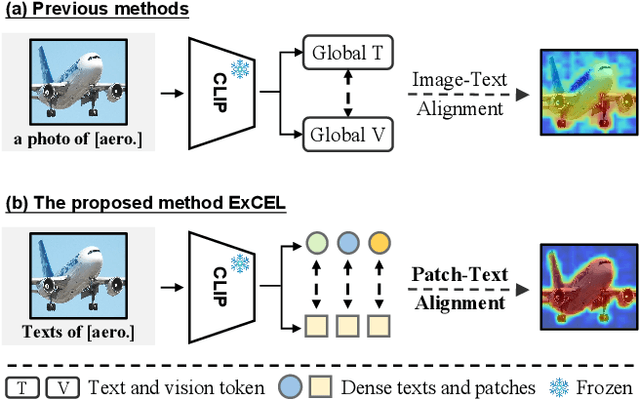
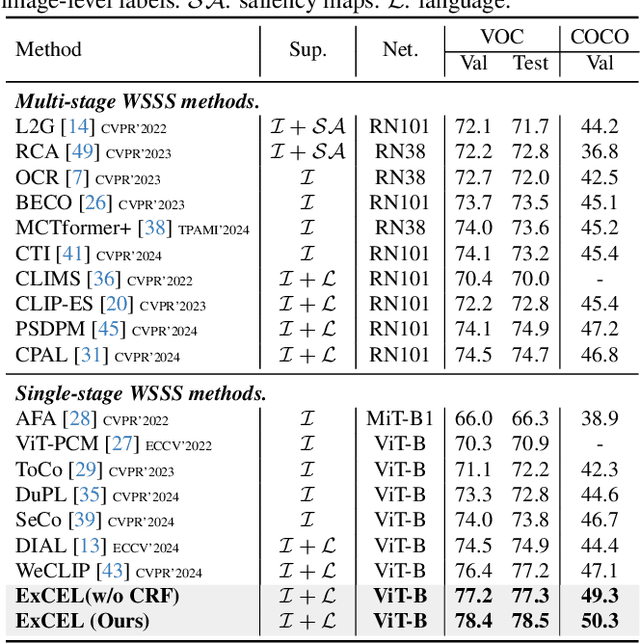
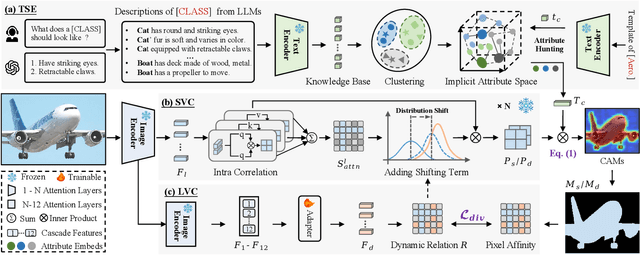
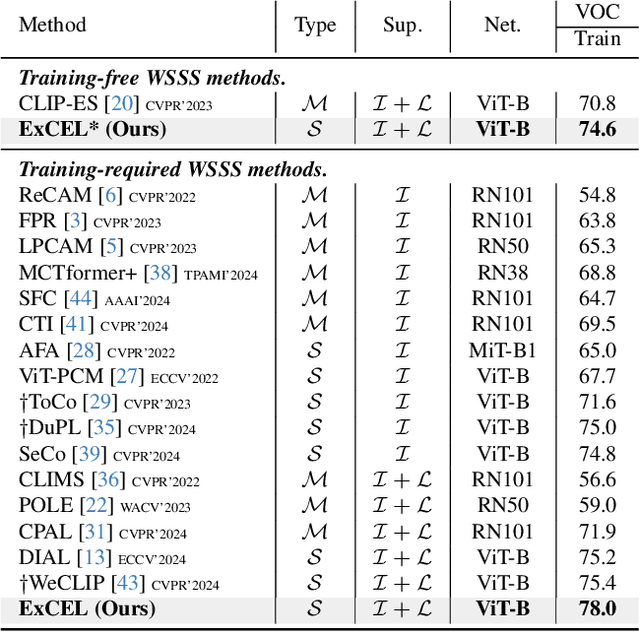
Weakly Supervised Semantic Segmentation (WSSS) with image-level labels aims to achieve pixel-level predictions using Class Activation Maps (CAMs). Recently, Contrastive Language-Image Pre-training (CLIP) has been introduced in WSSS. However, recent methods primarily focus on image-text alignment for CAM generation, while CLIP's potential in patch-text alignment remains unexplored. In this work, we propose ExCEL to explore CLIP's dense knowledge via a novel patch-text alignment paradigm for WSSS. Specifically, we propose Text Semantic Enrichment (TSE) and Visual Calibration (VC) modules to improve the dense alignment across both text and vision modalities. To make text embeddings semantically informative, our TSE module applies Large Language Models (LLMs) to build a dataset-wide knowledge base and enriches the text representations with an implicit attribute-hunting process. To mine fine-grained knowledge from visual features, our VC module first proposes Static Visual Calibration (SVC) to propagate fine-grained knowledge in a non-parametric manner. Then Learnable Visual Calibration (LVC) is further proposed to dynamically shift the frozen features towards distributions with diverse semantics. With these enhancements, ExCEL not only retains CLIP's training-free advantages but also significantly outperforms other state-of-the-art methods with much less training cost on PASCAL VOC and MS COCO.
DM-Mamba: Dual-domain Multi-scale Mamba for MRI reconstruction
Jan 14, 2025The accelerated MRI reconstruction poses a challenging ill-posed inverse problem due to the significant undersampling in k-space. Deep neural networks, such as CNNs and ViT, have shown substantial performance improvements for this task while encountering the dilemma between global receptive fields and efficient computation. To this end, this paper pioneers exploring Mamba, a new paradigm for long-range dependency modeling with linear complexity, for efficient and effective MRI reconstruction. However, directly applying Mamba to MRI reconstruction faces three significant issues: (1) Mamba's row-wise and column-wise scanning disrupts k-space's unique spectrum, leaving its potential in k-space learning unexplored. (2) Existing Mamba methods unfold feature maps with multiple lengthy scanning paths, leading to long-range forgetting and high computational burden. (3) Mamba struggles with spatially-varying contents, resulting in limited diversity of local representations. To address these, we propose a dual-domain multi-scale Mamba for MRI reconstruction from the following perspectives: (1) We pioneer vision Mamba in k-space learning. A circular scanning is customized for spectrum unfolding, benefiting the global modeling of k-space. (2) We propose a multi-scale Mamba with an efficient scanning strategy in both image and k-space domains. It mitigates long-range forgetting and achieves a better trade-off between efficiency and performance. (3) We develop a local diversity enhancement module to improve the spatially-varying representation of Mamba. Extensive experiments are conducted on three public datasets for MRI reconstruction under various undersampling patterns. Comprehensive results demonstrate that our method significantly outperforms state-of-the-art methods with lower computational cost. Implementation code will be available at https://github.com/XiaoMengLiLiLi/DM-Mamba.